

Steam Cleaning in Toronto & the GTA
Commercial and industrial steam cleaning for grease, grime, residue, and hard-to-clean surfaces. High-temperature steam loosens and removes buildup from equipment, tile, grout, walls, floors, and detailed surfaces — with less mess and lower chemical use than harsher blasting methods. A controlled option for active facilities that need to keep disruption low.
Serving commercial and industrial facilities across Toronto and the GTA.
Some Cleaning Jobs Need Precision, Not Blasting
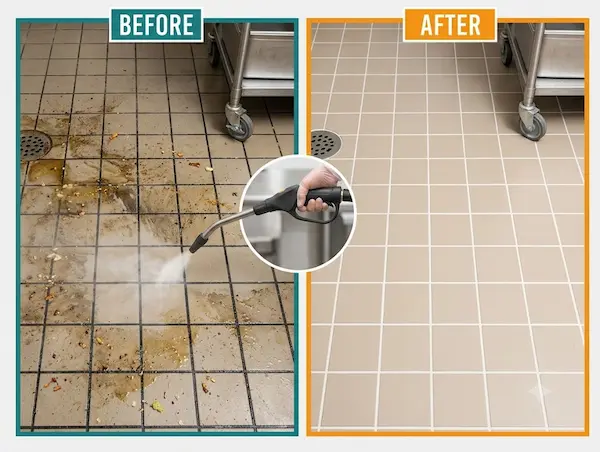
Abrasive blasting methods — dry ice, sandblasting, walnut shell, and similar approaches — are not always the right fit. They create cleanup of their own, require clearing nearby areas, and can damage surfaces that need more careful treatment.
Steam cleaning is the better choice when grease, residue, and buildup need to be removed with control. It reaches detailed and hard-to-access areas, keeps chemical use lower, and leaves less mess behind for the facility to deal with after the job.
Where Steam Cleaning Works Well
Steam cleaning is effective across a wide range of surfaces and environments. Common applications include:
✓ Equipment detailing and degreasing
✓ Greasy walls, floors, and stair treads
✓ Production lines, industrial equipment, glass, and smooth or textured surfaces
✓ Washrooms and change rooms
✓ Food-contact surfaces and food prep areas
✓ Tile, grout, corners, and hard-to-reach surfaces
Advantages of Steam Cleaning
Controlled application
Nearby areas often do not need to be cleared, keeping disruption low in active facilities
Lower chemical residue
High-temperature steam does much of the work, reducing the need for harsh chemical application
Minimal post-service cleanup
No blasting media to collect, less residue left behind compared to abrasive methods
Food-safe approach
Can be set up for food-contact areas and production environments where chemical use needs to stay low
Cost-effective for targeted work
Precise application means resources go where the buildup actually is
Effective alternative to harsher methods
Suitable replacement for dry ice, walnut shell, sandblasting, and other media blasting approaches
How the Steam Cleaning Process Works
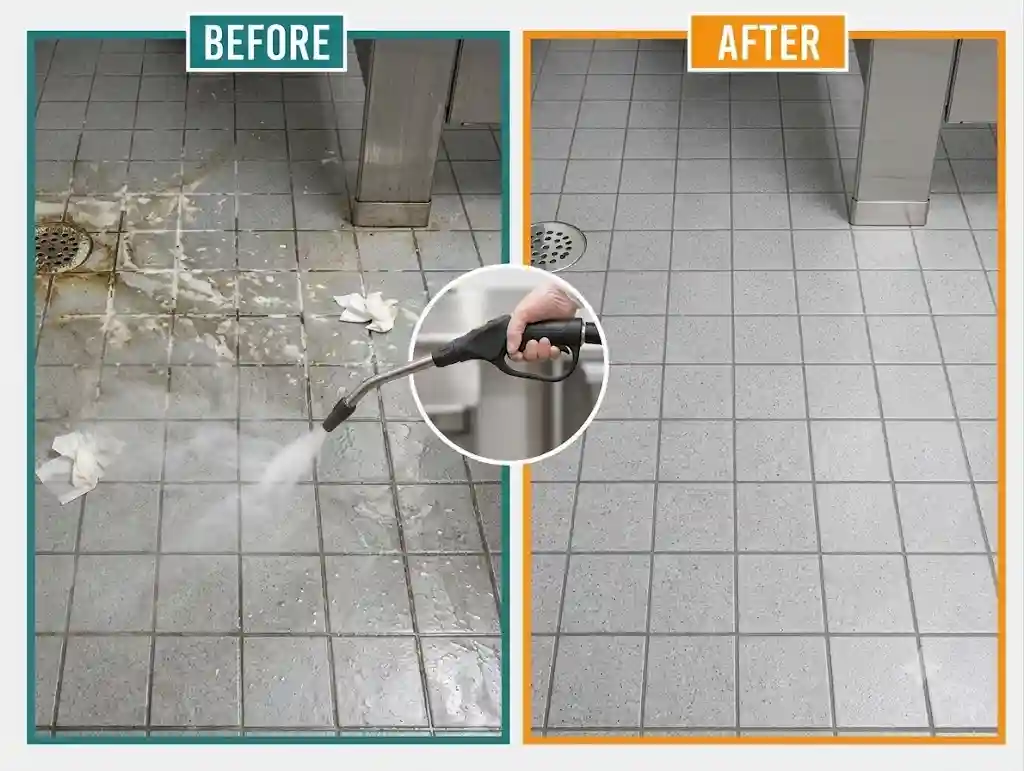
High-temperature steam is applied through focused nozzles directly to the surface being cleaned. The heat loosens and breaks down grease, oils, grime, and residue, which are then flushed or wiped away. Because the process relies on controlled heat and moisture rather than high-pressure water volume, it uses significantly less water than power washing and leaves surfaces ready to return to use more quickly.
For industrial plant sanitation, the process typically follows a structured multi-step workflow:
1. Pre-rinse with water to remove gross soils and product residue from equipment
2. Wash with detergents to clean equipment surfaces
3. Rinse to remove detergent residue
4. Treatment with sanitizing agents and final rinse where required
Key Benefits of Steam Cleaning
Deep Cleans uses a full range of steam cleaning equipment, matched to the surface and scope of each job — from compact handheld units for detailed spot work to heavy-duty industrial machines for production lines and large facilities.
REA Super — Dry Steam 9kW Generator
The REA Super is a heavy-duty industrial dry steam unit designed for large production facilities and demanding commercial environments.
For smaller or more precise jobs, compact handheld steam units are used to reach detailed areas, corners, and surfaces that larger equipment cannot access as effectively.
Stainless steel body
(AISI 304)
Steam production
37.2 lbs/hr (16.9 kg/hr)/p>
Detergent injection
With adjustable flow rate
Operating pressure
175 psi / 12 bar
Boiler temperature
375°F / 180°C
Nozzle operating temperature
302°F / 150°C
Low-voltage
24V operator control with high-density hose
Key Benefits of Steam Cleaning
Kills Microorganisms With High Heat
Heat above 248°F (120°C) destroys microorganisms in harborage locations and biofilms, with no risk of chemical resistance.
Uses Far Less Water
Uses up to 95% less water and produces up to 95% less wastewater compared to power washing.
Faster Drying And Turnaround
Surfaces heat-dry quickly and are ready for use sooner after cleaning.
Works On Any Surface Type
Effective on both smooth and textured surfaces.
Breaks Down Oils And Grease
Melts oils and greases, making them easier to remove from equipment surfaces.
Reaches Difficult Areas
Reaches detailed and hard-to-access areas that other methods cannot.
Where Steam Cleaning Works Well
Steam cleaning is effective across a wide range of surfaces and environments. Common applications include:
✓ Heat above 248°F (120°C) destroys microorganisms in harborage locations and biofilms, with no risk of chemical resistance.
✓ Melts oils and greases, making them easier to remove from equipment surfaces
✓ Surfaces heat-dried quickly and are ready for use sooner after cleaning
✓ Uses up to 95% less water and produces up to 95% less wastewater compared to power washing
✓ Effective on both smooth and textured surfaces
✓ Reaches detailed and hard-to-access areas that other methods cannot
Commercial and Industrial Steam Cleaning
Steam cleaning applies to both commercial and industrial environments. The method and equipment are matched to the specific facility, surface type, and level of buildup involved.
Commercial Settings
Steam cleaning is commonly used for kitchen equipment, tile and grout, washrooms, and food prep surfaces.
Industrial Settings
It is used for production line equipment, greasy work surfaces, floors, walls, and areas requiring controlled sanitation without heavy chemical application.
The Steam Cleaning Process
A straightforward approach from assessment to completion:
STEP – 01

Review the surface and scope
Assess the buildup type, surface material, and cleaning requirements
STEP – 02
Select the right equipment
Match the steam unit and setup to the job
STEP – 03
Apply steam and loosen buildup
High-temperature steam breaks down grease, grime, and residue
STEP – 04
Remove loosened soil
Flush or wipe away loosened buildup from the surface
STEP – 05
Apply sanitizing steps where required
Food-contact and regulated surfaces treated with sanitizing agents as needed
STEP – 06
Final check
Confirm surfaces are clean and ready to return to use
Why Clients Choose Deep Cleans for Steam Cleaning

Commercial & Industrial Experience
Steam cleaning carried out in both facility types across Toronto and the GTA
Equipment Matched To The Job
Range of steam units from detailed handheld work to heavy-duty industrial machines
Lower-Mess Alternative To Blasting
Effective results with less disruption to the surrounding area
Food-Safe & Sanitation-Capable
Suitable for food-contact surfaces and environments with sanitation requirements
Practical For Grease & Residue Removal
High-temperature steam handles the buildup that surface wiping cannot
Surfaces Ready To Use Sooner
Heat drying means less downtime after the job is done
Frequently asked questions
What surfaces can be steam cleaned?
Steam cleaning works on a wide range of surfaces including equipment, tile and grout, walls, floors, stair treads, glass, washroom surfaces, food prep areas, and both smooth and textured materials. It is effective in commercial kitchens, industrial production environments, and any space with grease, grime, or residue buildup.
Is steam cleaning only for industrial facilities?
No. Steam cleaning is used in both commercial and industrial environments. It is commonly applied in commercial kitchens, food service operations, and retail facilities, as well as in warehouses, factories, and production lines. The method and equipment are adjusted based on the environment and scope of work.
Can steam cleaning be used on food-contact surfaces?
Yes. Steam cleaning can be configured for food-contact surfaces and food prep areas. The process uses high-temperature heat rather than heavy chemical application, making it a practical option for environments where chemical residue needs to stay low. A sanitizing step can be included where required.
How is steam cleaning different from pressure washing or blasting?
Pressure washing uses high volumes of water at high pressure, which creates significant wastewater and can require clearing nearby areas. Blasting methods use abrasive media that require collection and cleanup after the job. Steam cleaning uses controlled heat and moisture, produces up to 95% less wastewater than power washing, and leaves less residue behind — making it a lower-mess option for active facilities.
Is steam cleaning effective for grease and grime buildup?
Yes. High-temperature steam melts oils and greases, making them significantly easier to remove from equipment and surfaces. It is one of the more effective methods for grease buildup in commercial kitchens and industrial production environments, particularly in detailed or hard-to-access areas where other methods are difficult to apply precisely.
Book Steam Cleaning for Your Facility
Commercial and industrial. Toronto & GTA. Contact us to discuss the scope and get a quote.